
Tag Archive for: architecture

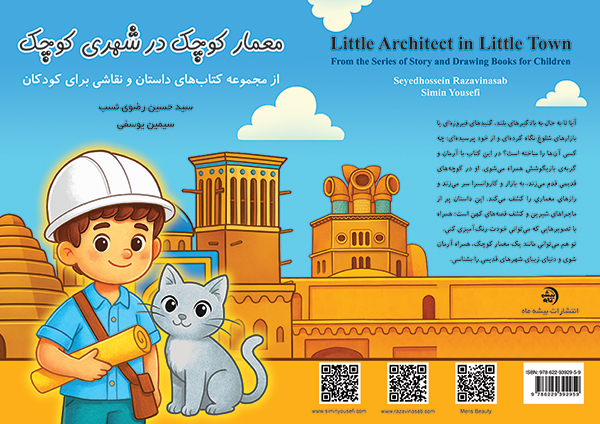
Little Architect in Little Town (معمار کوچک در شهری کوچک)

Titel in English: Little Architect in Little Town

Subtitle in English: From the Series of Story and Drawing Books for Children

Titel in Persian: معمار کوچک در شهری کوچک

Subtitel in Persian: از مجموعه کتاب‌های داستان و نقاشی برای کودکان

Date: November 30, 2025

Publisher: Bisheh Mah

Authors: Seyedhossein Razavinasab. Simin Yousefi

ISBN: 978-622-93929-5-9

Language: Persian
Link in Research Gate


Book Summary

Title: Little Architect in Little Town

Little Architect in Little Town is an educational children’s story written in a simple and engaging language. The book takes young readers on an adventurous journey through Iranian traditional architecture and historic buildings.

Arman, a curious young boy, walks through the old streets of his town with his playful cat. Along the way, he discovers the wonders of traditional architecture, including windcatchers, turquoise mosque domes, old bazaars, caravanserais, ice houses, and historic landmarks such as Shah Firouz and the Stone Garden.

During his journey, Arman meets different people such as a coppersmith, an architect, a builder, and a surveyor. Through these encounters, he learns that every building is the result of careful thinking, patience, and teamwork. The story encourages children to ask questions, think deeply, and explore the world around them.

Beyond strengthening curiosity and observation skills, the book teaches children about respect for cultural heritage, the intelligence of traditional architecture, and the important role architects play in creating better living spaces. In the end, the story plants the dream of becoming an architect in the hearts of young readers.

Promoting Sustainability

Buildings can contribute to raising awareness about sustainability, and some sustainable designers use their projects as educational tools. Clients, local authorities, consultants, builders, building users, and the general public can learn about sustainability both from completed buildings and from the construction process itself.

Learning how sustainable buildings operate not only increases awareness but also supports more efficient building performance. The success of a sustainable design strategy largely depends on how occupants use the building. Certain aspects of sustainable design are vulnerable to misuse, which can undermine their benefits. For example, even a well-insulated building will consume large amounts of heating energy if its windows are left open frequently. Unless occupants understand how the building works and the rationale behind its design, its performance is likely to suffer.

A comprehensive sustainable building design strategy should therefore include raising overall awareness about sustainability, educating clients and project teams on sustainable design approaches, and informing users about how the building functions. In addition, sustainable buildings should be monitored, and their design strategies and performance evaluated. This process can promote sustainable design by enhancing collective knowledge and understanding of how sustainable buildings perform, while also preventing the repetition of unsuccessful design practices.

In some cases, the building itself is used as an educational or demonstrative tool to showcase how effective sustainable design systems can be and how easily they can be integrated into a structure. Sometimes, information about environmental issues and building design is displayed within the building for visitors and users.

In all projects, opportunities for enhancing sustainability begin with setting appropriate goals to achieve a sustainable building. Clients—the individuals who ultimately commission and finance building projects—play a crucial role. The first step is to ensure that they are aware of the importance of sustainability and the potential for development it holds. The benefits of sustainable buildings are increasingly being recognized and quantified, and many completed projects exist that can demonstrate these benefits to potential clients.

References:
1. Razavinasab.Seyedhossein, Yousefi.Simin, California Academy of Sciences The 21st Century Noah’s Ark, 2025
2. Sassi, P., Strategies for sustainable architecture. 2006: Taylor & Francis.

The Role of LEED in the Future of Sustainable Architecture and Urban Planning

In the face of environmental crises, resource scarcity, and global climate change, the role of systems such as LEED will become increasingly significant in the future of architecture and urban development. As an international standard tool, LEED not only provides a technical framework for designing green buildings but also guides architects, urban planners, and investors toward sustainability. By integrating science, technology, and policymaking, this system directs projects toward energy efficiency, pollution reduction, and improvement of urban quality of life.

Looking ahead, LEED can serve as a global platform for integrating environmental policies into cities. With population growth and urban expansion, challenges such as traffic, pollution, excessive energy consumption, and urban heat are on the rise. Certifications like LEED can become enforceable tools in urban construction laws, ensuring that only projects meeting minimum sustainability criteria are granted permission for construction or operation.

Moreover, LEED is not limited to individual buildings. Versions such as LEED for Neighborhood Development make it possible to assess sustainability at the scale of neighborhoods, districts, or even entire cities. As a result, the future of urban planning can be based on a set of strategies for public transportation, green spaces, land use, carbon reduction, and the promotion of social equity.

In the field of architecture, LEED not only helps optimize the technical performance of buildings but also acts as a driver of innovation in design, the use of smart technologies, and the enhancement of the architect’s role in sustainable development. Architects of the future will increasingly need a deep understanding of concepts such as life cycle assessment of materials, net-zero energy, and climate-responsive design.

Ultimately, LEED can become recognized as a global benchmark of building quality—one that goes beyond aesthetics to represent the environmental, social, and economic performance of a building or city. Therefore, adopting and expanding the use of this system in developing countries is not merely a technical choice but a strategic necessity for conserving resources, enhancing public well-being, and joining the global movement toward sustainable development.

References:
1. Razavinasab.Seyedhossein, Yousefi.Simin, California Academy of Sciences The 21st Century Noah’s Ark, 2025