
فرهنگستان علوم کالیفرنیا کشتی نوح قرن 21 (California Academy of Sciences The 21st Century Noah’s Ark)
Titel in English: California Academy of Sciences The 21st Century Noah’s Ark
Titel in Persian: فرهنگستان علوم کالیفرنیا کشتی نوح قرن 21
Date: September 2025
Publisher: Bisheh Mah Publishing
Authors: Seyedhossein Razavinasab. Simin Yousefi
ISBN: 978-622-93929-4-2
Language: Persian
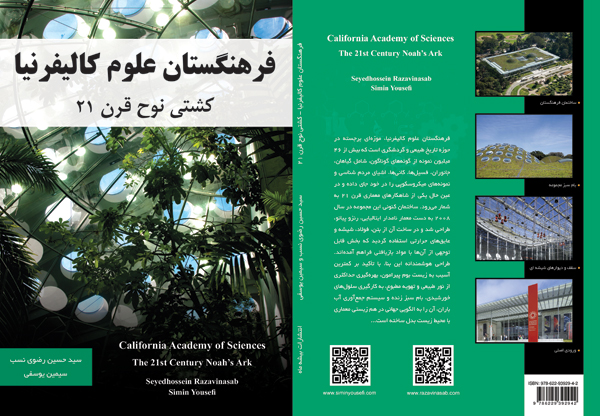
The Book Summary:
The book, titled “California Academy of Sciences: The 21st Century Noah’s Ark,” authored by Seyed Hossein Razavinasab and Simin Yousefi, provides a comprehensive look into the history of the California Academy of Sciences and its reconstruction through the lens of sustainable architecture. The book presents the Academy, located in San Francisco, as a leading global example of the convergence of science, nature, and sustainable design. The redesigned building, created by renowned Italian architect Renzo Piano, is a unique model of sustainable design, renewable energy use, and biodiversity preservation in the heart of a modern city.
The book is organized into four main chapters:
Chapter 1: History
This chapter details the formation and historical evolution of the Academy since its founding in 1853. It covers key milestones, from its origins with seven amateur naturalists to becoming one of the most popular destinations in the American West. Significant events are chronicled, such as the devastating 1906 earthquake and fire that destroyed the museum, and the 1989 Loma Prieta earthquake, which caused severe structural damage and ultimately led to the decision to rebuild the entire complex. This reconstruction was seen as an opportunity to create a 21st-century institution that could reconnect visitors with the natural world and advocate for its protection.
Chapter 2: Sustainable Architecture
The second chapter delves into the principles of sustainable architecture that guided the design of the new Academy. This section covers a wide range of topics, including:
- Land Use: Emphasizing minimal ecological footprint and harmony with nature.
- Sustainable Communities: The importance of creating spaces that enhance quality of life through education, employment, and well-being.
- Health and Well-being: Focusing on thermal comfort, air quality, and avoiding “insensible agents of disease” through careful material selection and design.
- Sustainable Materials: Using recycled, local, and low-embodied-energy materials. The book introduces concepts like Life Cycle Assessment (LCA) to evaluate materials.
- Energy Optimization: Employing passive design strategies and renewable energy sources like solar power to significantly reduce energy consumption.
- Water Management: Utilizing efficient systems for water conservation, including rainwater harvesting and greywater recycling.
Chapter 3: The LEED Rating System
This chapter focuses on the LEED (Leadership in Energy and Environmental Design) certification system, a global standard for green buildings. It explains the history, structure, and main criteria of LEED, such as Sustainable Sites, Water Efficiency, Energy & Atmosphere, and Indoor Environmental Quality. The California Academy of Sciences notably achieved two Platinum LEED certifications—the highest possible level—one for its initial design and construction in 2008 and another for its operations and maintenance in 2011.
Chapter 4: Location and Spaces
The final chapter explores the Academy’s geographical location in the heart of Golden Gate Park and analyzes its various spaces, designed by Renzo Piano. Key architectural and programmatic features discussed include:
- The Living Roof: A 2.5-acre roof planted with over 1.7 million native Californian plants. It acts as a natural insulator, absorbs nearly 98% of rainwater, and provides a habitat for local wildlife.
- Steinhart Aquarium: Located on the lower level, it showcases diverse marine ecosystems, including a Philippine Coral Reef and the California Coast.
- Osher Rainforest: A four-story glass dome that houses over 1,600 living creatures, recreating a tropical rainforest ecosystem.
- Morrison Planetarium: One of the world’s most advanced all-digital planetariums, offering immersive journeys through space.
Ultimately, the book positions the California Academy of Sciences as a symbol of the constructive interaction between humanity, nature, and technology, serving as a successful and influential model for sustainable development worldwide.